
7 Locations to Discover Petroglyphs on the Big Island
Visiting petroglyphs on the Big Island is a unique-to-Hawaii activity.
Ancient Hawaiians carved figures and symbols into lava rocks hundreds of years ago and no one is 100% sure what they all mean.
When I lived on the Big Island for a year, I enjoyed hunting for petroglyphs all over, from north of Kona and then down in Hawaii Volcanoes National Park.
No two petroglyph locations are the same so it’s hard to recommend one over the other. Here are 7 places to find petroglyphs on the Big Island. Learn about them and decide which sites sound the most appealing to visit.
What are Petroglyphs?
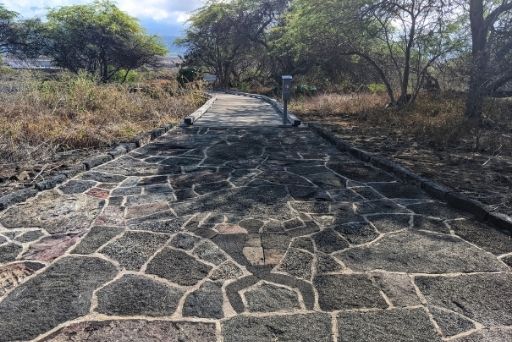
Hawaiian petroglyphs, or ki’i kohapu, are an ancient lava carving practice and quite mysterious. Experts believe they can have a variety of explanations whether depictions of everyday life and historical events, or symbolisms and metaphors, or even being used for medicinal and spiritual rituals.
Considering the kind of effort that was needed to chip away at lava rock to carve the images, you know that each picture and placement must have been very intentional.
Petroglyphs are best seen in the early morning light or late afternoon as the long shadows from low light help define the outlines best. Surprisingly, it’s hard to see petroglyphs in the dark with a flashlight; it washes them out almost completely as if they aren’t even there (figured that one out the hard way!).
1. Kaloko-Honokōhau National Historical Park
Between Kona town and Kona International Airport is the Kaloko-Honokohau National Historical Park.
This area is considered an ahupua’a, a section of land that extends from the mountain to the sea providing all the necessary items for survival. Food could be harvested from the ocean, the nearby freshwater pond, and the fertile land (which isn’t so fertile anymore).
Take the trail from the parking lot that leads to the white sand beach.
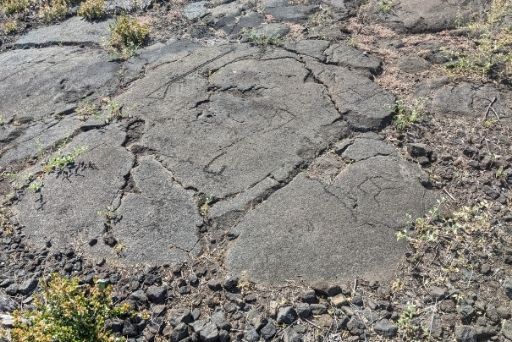
Walk about 10-15 min from the visitor center over a half-paved path past fishponds and heiau/hale ruins. Soon you’ll come to a short petroglyph viewing boardwalk.
These petroglyphs are a bit faded and some can be hard to see, especially if the sun is higher up in the sky. Thankfully, benches mark areas where petroglyphs can for sure be seen.
Human figures seem to be in clusters of ohana, or families. And a rifle icon sticks out like a sore thumb.
One thing that sets this petroglyph site apart from others is the amount of women represented here. Of all the petroglyphs in all of Hawaii only about 20% clearly define women. Here at Kaloko-Honokohau, 40% of its petroglyphs are women. What could be the meaning behind that?
Another distinctive image carved here is the papamu, a checkerboard of small holes. Most explanations say it was a gameboard for konane (Hawaiian checkers game) or for divination. Others say it could have also been used as a calendar, abacus, and other ways of keeping track of various information.

2. Kohanaiki Beach Park
At the end of a long road through a golf course and rocky goat perches is Kohanaiki Beach Park, a local’s favorite surfing beach of 0.5-mile stretch of white sand and nugging waves.
At the end of the one lane paved road is a short historical path with a pond where endangered Hawaiian stilts like to hang, a hale with grass roof, a curated edible garden with a star compass, and…wait for it…a petroglyph.
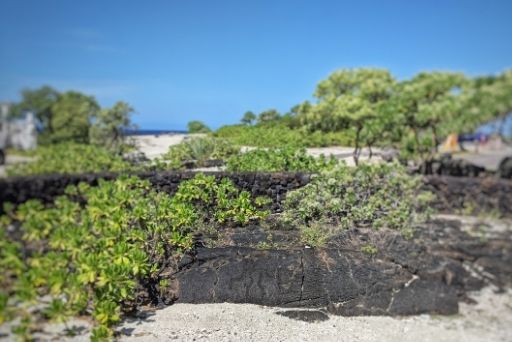
A circular lava rock wall protects the singular petroglyph that resides in the middle. A stone step up next to the rock wall lets you know where to stand in order to see it.
There are other petroglyphs scattered throughout the park (I’m not sure where), but this is one that’s marked for easy viewing.
3. Waikoloa Petroglyph Reserve
Waikoloa Petroglyph Reserve is probably the most bang for your buck for petroglyph viewing on the Big Island. It’s easily accessible, more of a stroll rather than a hike, and there are lots of petroglyphs to be found.
Park in the King’s Marketplace parking lot in Waikoloa, the closer to the Shell gas station the better. Walk along the paved sidewalk on Pohakulana Place until you reach the end of the road and the path veers towards the golf course.
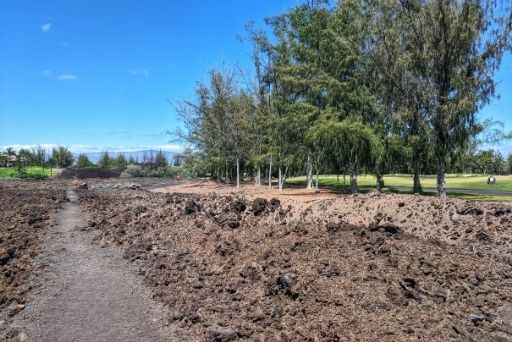
You’ll notice a gravel path down in the pit marked the King’s Highway Foot Trail. This is part of the ancient 175-mile trail that goes from Upolu Point all the way to Hawaii Volcanoes National Park. This trail was a major “highway” connecting communities, temples, fishing spots, and other important locations. Ali’i, or royalty, would also take this trail for religious ceremonies and events.
Now, one observation I am noticing…this trail is suspiciously close to all the main petroglyph sites. Coincidence? Unlikely.
Anyways, I digress…there are two trailheads for the Waikoloa Petroglyph Reserve. One is here by the golf course bathrooms, which takes you across the lava field, over rocky terrain and the trail kinda disappears for a bit (I still haven’t found the correct trail that gets all the way across lol!).
The one I prefer entering is on the opposite side of the field which is accessible by following the golf cart paved path. Of course you’ll have to be extra careful during tee time hours for fly balls, but it’s easier on the feet and obviously more clearly marked.
From this entrance the trail becomes clearly defined and a little less rough than the entrance at the other end, although you still need to watch your steps.
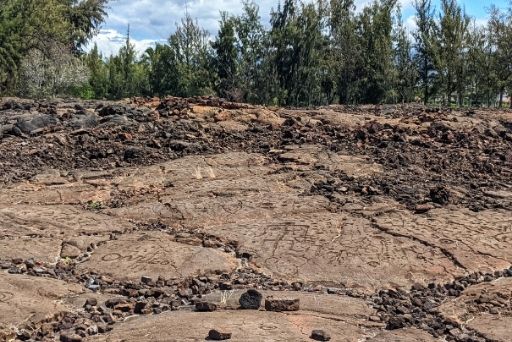
The petroglyphs reside on this far end of the lava field. Keep your eye out for all kinds of drawings.
Some carvings that make this location unique is the depiction of Western influence. One in particular is of a person riding a horse. Others are English letters. So you might consider these carvings “modern art”.
Labeled on the path are also C-shaped stone windbreaks, something not found at other petroglyph sites.
4. Kalahuipua’a Historic Park
Kalahuipua’a Historic Park resides adjacent to Mauna Lani Resort. View ancient fishponds, a lava tube, and petroglyphs in this park.
One site describes the Kalahuipua’a Historic Park trail as a 1.7-mile lollipop loop trail; love that description!
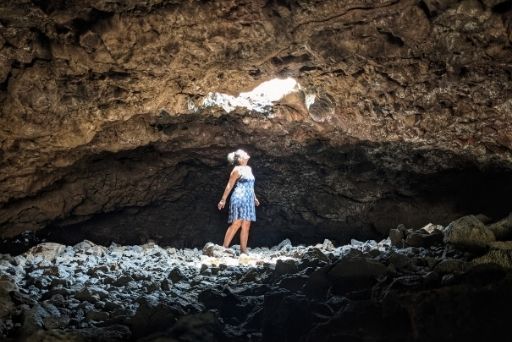
Along the first portion of the rolling trail you’ll cross a lava field. A lava tube entrance is about halfway through this portion off of the paved trail into the trees to the right. Hawaiians used this lava tube as a shelter from the 1500s-1700s. Half-way through the cave is a “skylight”, a popular spot for pictures.
Before the trail hits the fishponds at around 0.35-miles, it meets up with the King’s Highway Foot Trail, which you can walk from the Waikoloa Petroglyph Reserve only 2 miles away.
From the Kalahuipua’a paved path turn left onto the King’s Highway Foot Trail. You’ll be led to a couple of petroglyphs. See if you can find the helmeted warrior and the fisherman (I couldn’t find them).
If you wish to continue on the “lollipop” portion of the trail you can follow it around the Kalahuipua’a Fishponds. The ponds cover about 4-acres and some reach depths of 20ft. Fish were trapped and plumped up before being fed to ali’i, or royalty.
5. Puako Petroglyph Park
Next door to the Fairmont Orchid are the Puako petroglyphs, a 1.5mile roundtrip hike.
You’ll park at Holoholokai Beach Park. Take a peek at the shoreline, constructed of starkly contrasting black lava rocks with white coral line the shore. Picnic tables are availabe to enjoy an al fresco lunch before or after your hike.

The Malama trailhead (to Puako petroglyphs) begins at the parking lot entrance. Follow it a couple of minutes until you reach a ring of petroglyph replicas.
If you feel inclined to make a rubbing of a petroglyph you are allowed to use these. Rubbing real petroglyphs is prohibited.
From here the trail heads into a bushy portal where you enter a mystical Kiawe forest grove. The tangle of branches encompass you and feels other worldly. Watch your step and your head as roots and thorny branches try to take you out.
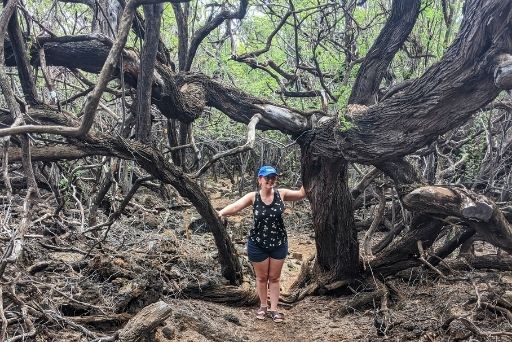
But the shade of the tree cave is a welcome respite from the desert sun out here in the Kohala sun.
If you have a keen eye, you might be lucky enough to spot some petroglyphs; at least, that’s what I’ve heard.
The forested trail eventually opens up to a more barren lava field with only a smattering of trees. Just when you begin to question how far you have to hike through this desert-esque terrain, the trail comes to an end upon a rugged lookout over the Puako petroglyph field.
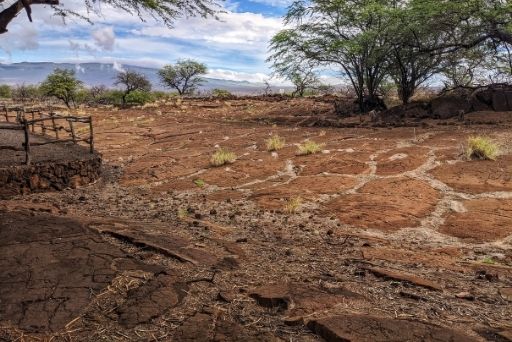
Some of these carvings date back to the 1200s. Most of the carvings you’ll see are of humans. Some are singles standing on their own and some are in family-type groups. It’s fun to ponder and wonder (Pwonder? Can that be a word?) who made these and why.
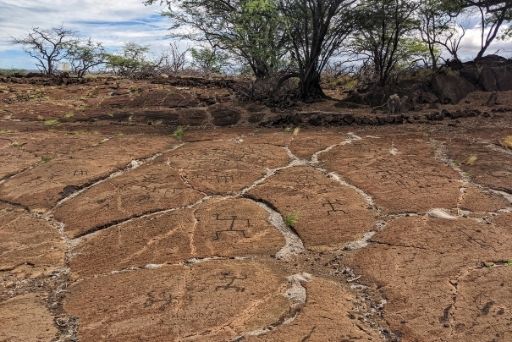
About 1,200 of the 3,000 petroglyphs are visible on this trail. I didn’t count them but feel free to crunch those numbers.
Stroll the semi-shaded path around the field Find a rock or stump to sit on and take in the mysterious rock canvas before you.
6. Paleaku Peace Gardens
This petroglyph stop is hardly worth mentioning, especially since there’s a $10 ticket fee, but I will in order to be as thorough as I can. The Paleaku Peace Gardens are a 7-acre botanical garden with beautiful, manicured grounds to explore and “meditate” in. You’ll find religions from around the world represented here.
Once you pass all the initial buildings you have the gardens expanding before you. Hang left to a grove of trees. There you’ll find a fenced off lava tube protected under the shade. A placard helps you locate where you can see the petroglyphs near the back of the cave wall.
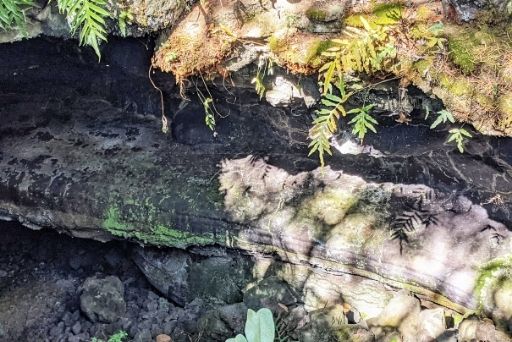
I had a hard time deciphering them. Perhaps it was the lighting from the time of day, I mistook them for cracks, or the carvings are too worn down after 800 years to see well. Regardless, they’re there.
7. Pu’u Loa Petroglyphs
The Pu’u Loa petroglyphs lie about 20 miles south from the Hawaii Volcanoes National Park entrance. It is my favorite petroglyph location on the Big Island.
Follow Chain of Craters Road until you almost reach the ocean. It will be apparent when you see pullouts for parking along the side of the road and an otherwise in-the-middle-of-nowhere placement for a call box and trail placard.
This trail is a mostly flat, 1.5mile roundtrip trail over pahoehoe lava rocks and zero shade. I would recommend hitting the trail early in the morning or late afternoon to avoid the midday heat.
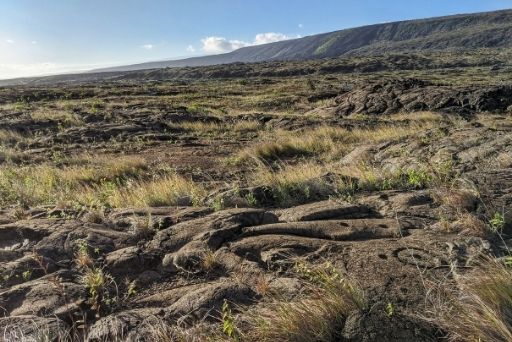
The rocky trail stays pretty clearly marked, although some ahu (cairns) help mark the way. It could get easy to get lost in this barren lava field if you weren’t paying attention. Luckily it’s a straight shot to the viewing area.
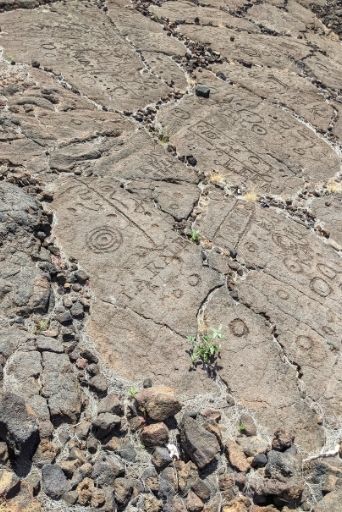
You’ll arrive at an out-of-place boardwalk for easily and safely viewing the petroglyphs.

The Pu’u Loa petroglyph collection has 23,000 carvings (!) and you will only view a fraction of them. Instead of people being the common theme, 85% are pukas, circles where a newborn’s umbilical cord was placed to ensure long life. I guess that’s one thing they do understand about a petroglyph symbol.
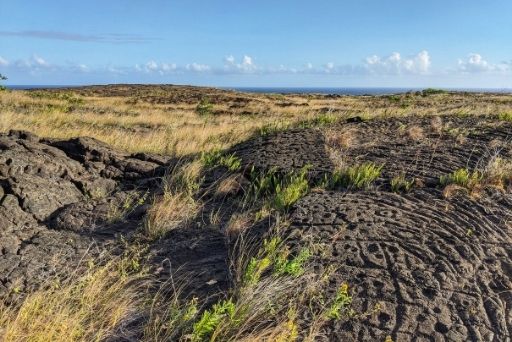
The boardwalk loop is a bit short for the effort it took to get here, so take in the gorgeous view of the valley and carvings for as long as you want.
On the way back I noticed a lot of stray “in the wild” petroglyphs off the side of the trail. I’m not sure if they are harder to see walking towards the boardwalk rather than away or if it had to do with the angle of the light. Whichever, keep an eye out and try not to walk on top of them.
Explore other natural wonders on the Big Island:
Big Island Hot Springs
Big Island Volcanoes
Makalawena Beach
Kua Bay Beach
Epilogue: Discover Petroglyphs on the Big Island
As you can see there are quite a few places to view petroglyphs on the Big Island. Some sites are larger areas to visit like Waikoloa, Puako, and Pu’u Loa and others just have a few carvings that may not be worth the effort unless you are already in the area like Paleaku Peace Gardens Garden and Kalahuipua’a Historic Park.
Petroglyphs are such a unique, historical aspect to the Big Island, a visit to at least one is necessary.
Did I miss a good Big Island petroglyph location? Send me an email!
🌺 Big Island Travel Planning Guide 🌺
🚨 Should I buy Hawaii travel insurance?
YES — I recommend Travel Insurance Master because you can compare multiple options with one click. With plans starting at $5/day per person, why not give yourself piece of mind? Better to have it and not need it than need it and not have it!
🚗 Is it safe to rent a car on the Big Island?
YES — It’s totally safe to drive on the Big Island. And unless you plan to chill by the resort pool the entire time, renting a car is pretty much a necessity on the Big Island! Jeep rentals are popular. I recommend Discount Hawaii Car Rental, as they have some of the best prices around.
📞 Will my phone work on the Big Island?
PROBABLY — Most, if not all, cell providers work on the Big Island. However, be prepared for some dead spots in the more remote parts of the island. For example, I always lose service driving through Hawaii Volcanoes National Park.
🛏️ What’s the best way to book my Big Island accommodations?
For Big Island hotels, Booking.com is amazing because you can often reserve your room with no money down. If you are looking for an Airbnb condo with a kitchen and more space, don’t forget to check VRBO for potentially better prices and options.
✈️ What’s the best site to buy Big Island flights?
I recommend looking at Skyscanner for finding cheap flights. Pro Tip: check if flying into Hilo is cheaper than flying into Kona.
🛂 Do I need a passport to visit Hawaii?
NO — If you are a US citizen, you do not need a passport as Hawaii is part of the United States. If you are from out of the country, the same passport and visa requirements are the same as entering anywhere in the United States from your country.
🧳What should I pack to the Big Island?
Pack for tropical weather but also prepare for colder than expected nights and early mornings, so a light sweatshirt is recommended. Check out this list of 5 Things Not to Forget to Pack.


