
Explore Panaewa Rainforest Zoo and Gardens in Hilo, Hawaii
Have you heard of the Panaewa Rainforest Zoo in Hilo, Hawaii?!
One of the best FREE things to do on the Big Island is to visit the Panaewa Rainforest Zoo and Gardens. Tourists and locals should take time to wander these animal and botanical laden grounds.
I lived on the Big Island for a year and visited this rainforest zoo multiple times because it was just so darn good!
Even if the Panaewa Rainforest Zoo and Gardens wasn’t free, it would still be a worthwhile place to visit. Animal lovers will enjoy seeing creatures they’ve probably only seen on the Discovery channel. Green thumbs can marvel at the native plant life, like up to 100 varieties of palms.
Panaewa Rainforest Zoo and Gardens Basic Info

Address: 800 Stainback Hwy, Hilo, HI 96720
Hours: 7 days a week 10:00am-3:00pm (closed Christmas Day and New Years Day)
Fee: FREE
Directions: A sign for the Panaewa Rainforest Zoo and Gardens sits on Hwy 11. Follow the signs up Stainback Hwy road just a mile before turning right. You’ll be led down a palm tree lined drive to a spacious parking lot.
Next door you’ll see the Panaʻewa Stampede Rodeo grounds.
History of Panaewa Rainforest Zoo and Gardens
Originally located next to Onekahakaha Beach Park, Panaewa Rainforest Zoo was first founded in 1968. From the beginning it was always intended to be a temporary location because there was no room for expansion, was in a tsunami zone, and had the potential to contaminate ocean water near swimming beaches and tide pools.
Its location was convenient for beach goers and by 1974, the zoo was receiving up to 90,000 per year.
In September 1978, Panaewa Rainforest Zoo moved to its current location at the Panaewa Recreational Complex. It’s currently situated on 12 acres of land and houses about 200 animals and 80 different species.
A lot of effort was also put into creating a multifaceted botanical garden to decorate the zoo, with 40 different species of plants, flowers and trees. The Hawaii County Council officially renamed the park to Panaewa Rainforest Zoo and Gardens in 2006.

The zoo’s popularity has grown to over 200,000 visitors a year (pre-Covid).
Today the zoo is a beautiful collection of rainforest plants and animals that compliment each other like a living art piece to be enjoyed by all.
FUN FACT:
The Panaewa Rainforest Zoo and Gardens is the only zoo in the United States located in a rainforest, receiving 125 inches of rain a year.
Let’s Go In!
Once you park your car, walk up the steps to the Panaewa Rainforest Zoo and Gardens gift shop. It’s not much, but they do offer souvenirs, rain gear, snacks, and beverages.
If you want a map to guide you through the grounds, you can purchase one in the shop or just take a picture of the one they have on the counter.
Exit through the back door and enter into a world of rainforest flora and fauna.
To the right you’ll be immediately greeted by two parrots, Max and Salsa. Max has the best, human sounding “Hello” I’ve ever heard from a parrot. Of course when I tried to actually have a conversation with him he hid away from me and shut up.
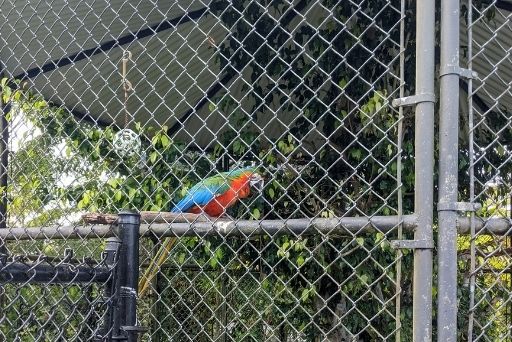
Adjacent to the parrot cages is a small, raised pond with Victoria water lilies that houses black swans.
If you missed the map inside the gift shop, a large bulletin board displays a large map for directing you around the zoo.
Also, notice also the animal shaped bench. There are many of these sponsored animal benches throughout the zoo created by artist/sculptor Charlene Lofgreen. A fun game might be to try to find them all and take a picture on each one!

As you wander through the zoo, keep your eyes open to the beautiful flora that volunteers have planted throughout the park making it into the botanical garden that it is. You’ll see orchids, ferns, bamboos and rhododendrons as well as plants native to the Hawaiian and Pacific islands like the crown flowers and snow bush.
Nightingale Donkeys, Emu, and ‘Alala
Staying to the right of the path, walking slightly uphill, you’ll reach a nightingale donkey and emu pen (why the two live together is an odd combo to me). While it might be tempting, don’t stick your fingers through the fence to pet the emu, they do bite.
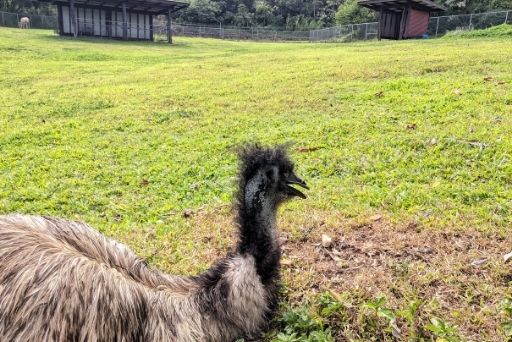
Across the path from the emu and donkey pen is I’o, the Hawaiian crow, or ‘alala. Unfortunately, the ‘alala are an extinct species in the wild. Fortunately, there’s one for you to see here!
But you may quickly get distracted by their next door neighbors: two bengal tigers!
Bengal Tigers
These tigers have called Panaewa Rainforest Zoo and Gardens their home since 2016, after they were donated by Great Cats World Park in Cave Junction, Oregon. Their first weekend home at the zoo brought in a record 5,000 visitors.
The white bengal tiger’s name is Tzatziki and the orange bengal tiger is Sriracha. I was surprised how small they are; more like giant house cats.
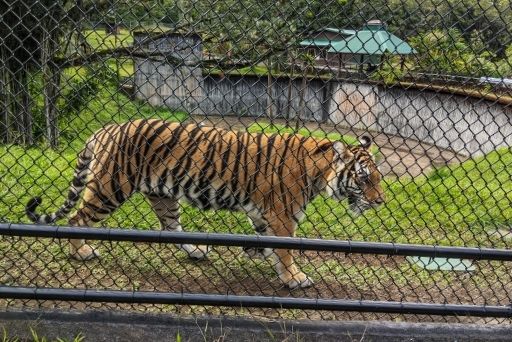
The tigers share a large pen, with plenty of toys. If you’re lucky, they might hang out near the fence so you have a close up view of them. If not, check in the back corners of the pen, they might be resting in the shade.
There is a covered pavilion overlooking the pen, a good place to view if it’s raining.
Continuing on the same path, past the tigers, are some more mellow exhibits like a silver pheasant, crowned crane, and some reptiles.

Lemurs and Binturongs
But then you might start hearing some screeches from around the corner that will peak your interest. Ring-tailed lemurs “like to move it move it”, playing loudly with each other.
Other times they might just be sitting quietly with arms stretched out reaching for all the sun rays they can get.
These are definitely some of the coolest animals here. I mean, who doesn’t love their long, striped tails (which I learned always has 13 stripes)?!
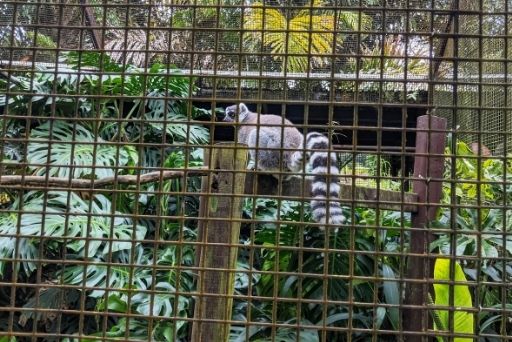
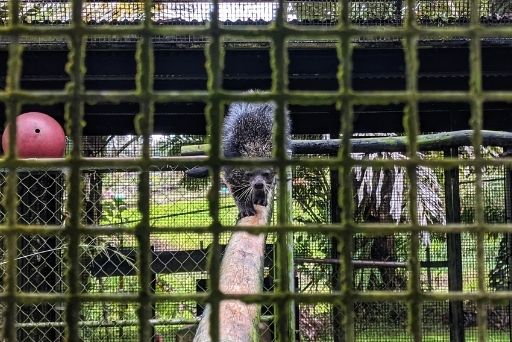
Backtracking just a hair thought, before you reach the lemur cage, see if you can find the binturong adjacent to the lemurs.
Do you know what a binturong is? I know I didn’t. It’s a “bearcat” found in South/Southeast Asia. They are nocturnal and like to nap on branches in the sunshine.
Monkeys
Keep on cruising down the path and your eyes will be drawn to the left by a large geodome cage. You have to walk through a magical vine tunnel which leads you straight to it.

This is a home with cute spider monkeys. Watch them climbing all over the place or perhaps just chilling way up high.
You’ll soon realize you’re in the primate section of the zoo as the following cages house kinkajous, marmosets, and capuchins.
Some of the fences are close enough to come eye to eye with these cuties. But resist the urge to reach in and pet them.
If a cage seems empty, check up in the corners where they could be resting and camouflaging with the shade.

Turtles, Tortoises and Sloths
Backtrack a little from the monkeys to view some turtles and tortoises.
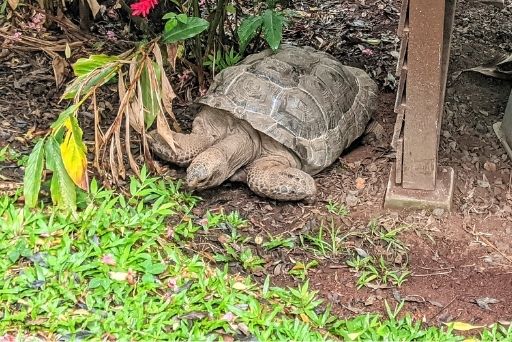
Do you know the easiest way to tell the difference between a turtle and a tortoise? A turtle will have a “water dynamic” flattish shell for swimming while the tortoise will have a more rounded dome shell.
Tucked in between these slow reptiles is another slow moving animal. Akala is a two-toed sloths that can be seen if she isn’t napping.
Akala came from the Honolulu Zoo, where her parents are. She has had two offspring since 2018.

Petting Zoo
The petting zoo is only open on Saturdays from 1:30-2:30pm. Under a covered pavilion, or open-air barn, you can get your hands on friendly animals like emus, box turtles, goats, and pigs.
Birds
More parrots, macaws and cockatoos are on a colorful display. See if one will strike up a conversation with you.
Tuesdays and Thursdays for 30min around noon, Romeo the Moluccan Cockatoo comes out for meet and greets, perhaps even to show off on a skateboard ride.
Iggie the turkey vulture is the oldest member in the zoo, born in 1983. The average lifespan of a turkey vulture is between 15-20 years in the wild, 30 years in captivity. So Iggie’s doing well for herself.
See if you spot the pueo, the Hawaiian Short-Eared owl.
Peacocks roam free around Panaewa Rainforest Zoo and Gardens. Keep an eye out for them strolling past you along the path.

Reptiles
There are no snakes in Hawaii and the government wants to keep it that way; even having snakes as pets is illegal in Hawaii. However, that doesn’t mean that people won’t smuggle them in and sell them illegally.
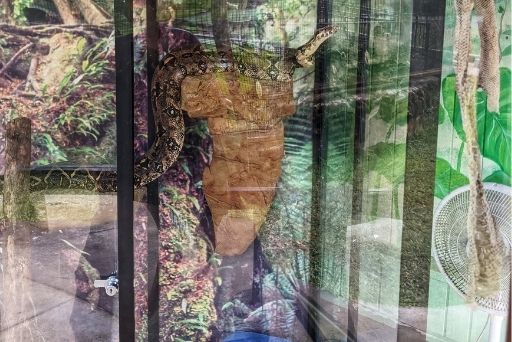
The boa constrictor at Panaewa Rainforest Zoo and Gardens was confiscated on Oahu from just that.
This monster of a snake is fascinating to look at through the glass. After shedding his skin the zoo will hang it up for you to see.
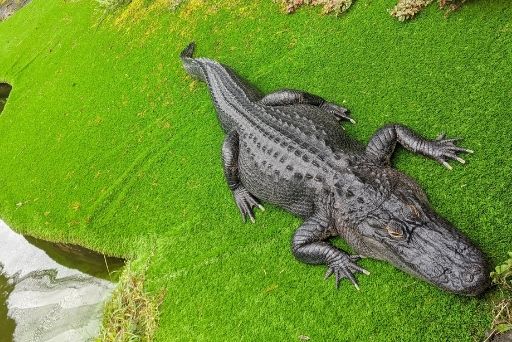
A pond homesan American alligator, Lilo, usually found basking in the warm sun. American alligators were once on the verge of extinction, but due to strict conservation measures, this reptile species is no longer endangered.
Alligator feedings are on Tuesdays, Thursdays, and Sundays at 1:30pm. Watch Lilo get some lunch!
A red iguana might be found chilling on a branch in its cage. Having never seen a large, bright red lizard before, I found it to be a super intriguing animal.

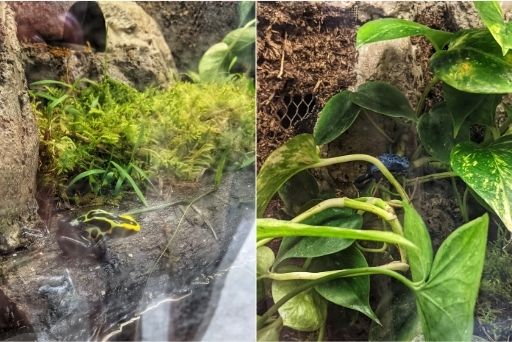
Across the way is the Jewels of the Rainforest reptile exhibit. I’m usually not one for reptiles but it was so cool to see poison dart frogs and red-eyed tree frogs, animals I’ve only seen in books or nature shows.
The covered pavilion also makes a nice respite from the sun or rain.
Playground
From here the path forks. You can go left to see a couple of more exotic birds in a row of cages.
But I would then backtrack to the right of the fork.
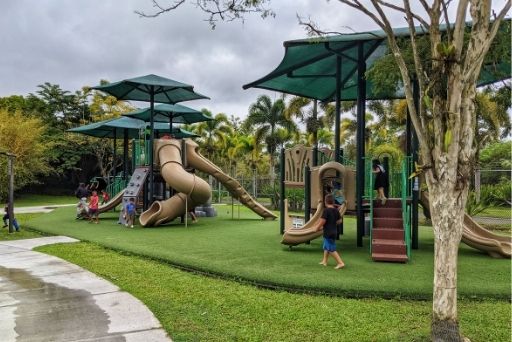
Here you’ll find a giant playground, probably covered in children. With all kinds of slides and climbing contraptions with a soft flooring and tent-like covering to protect from the elements, kids can exert any excess energy they have.
Picnic tables under pavilions provide shelter while eating pack lunches.
Anteaters and Nene
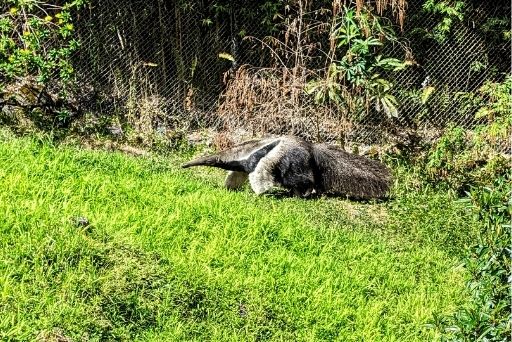
The last section of the Panaewa Rainforest Zoo and Gardens is a fun, meandering paved boardwalk over two giant anteaters, Penny Ant-E and Jerry.
Anteaters, found throughout Central and South America, may eat up to 30,000 ants or termites in a single day. And because they have long claws for digging at insects, they curl their claws under and walk on their “fists”.
I don’t think I’ve ever seen anteaters in person before so I was pleasantly surprised at how fun they are to watch! And they are surprisingly big…go figure!
As you’re strolling over the raised paved path you’ll also see a section full of birds like ducks, ibis, and my favorite – nene.
Nene is Hawaii’s state bird and is considered to be the rarest goose in the world as it is only found in Hawaii. Conservation efforts saved the nene from extinction and today there are 2,500 birds in the wild. If you didn’t see any while visiting Hawaii Volcanoes National Park, at least you can see them here!
Exit Panaewa Rainforest Zoo and Gardens
You are now back near where you started your tour through the Panaewa Rainforest Zoo and Gardens, just a few steps from the gift shop.
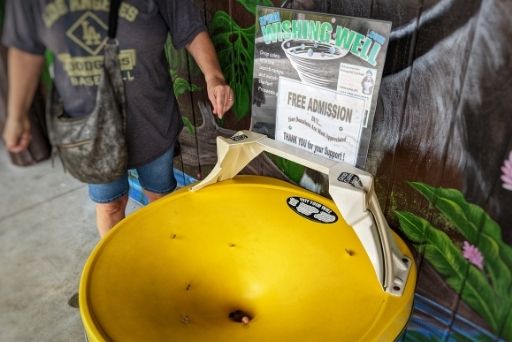
Before you exit, there is a donation bucket if you feel inclined to donate to this beautiful free zoo.
OR, you can “adopt” one of the animals for only $35.00. You’ll receive a photo of your adopted animal and a certificate of adoption. Pick a Panaewa Rainforest Zoo animal to adopt here.
Epilogue: Panaewa Rainforest Zoo and Gardens
You might be surprised to find a zoo on the Big Island but after visiting you’ll soon realize that Panaewa Rainforest Zoo and Gardens makes for a natural Hawaiian attraction.
You can’t beat this free attraction in Hilo, a beautiful place to visit whether you are an out of state tourist or a longtime local.
🌺 Big Island Travel Planning Guide 🌺
🚨 Should I buy Hawaii travel insurance?
YES — I recommend Travel Insurance Master because you can compare multiple options with one click. With plans starting at $5/day per person, why not give yourself piece of mind? Better to have it and not need it than need it and not have it!
🚗 Is it safe to rent a car on the Big Island?
YES — It’s totally safe to drive on the Big Island. And unless you plan to chill by the resort pool the entire time, renting a car is pretty much a necessity on the Big Island! Jeep rentals are popular. I recommend Discount Hawaii Car Rental, as they have some of the best prices around.
📞 Will my phone work on the Big Island?
PROBABLY — Most, if not all, cell providers work on the Big Island. However, be prepared for some dead spots in the more remote parts of the island. For example, I always lose service driving through Hawaii Volcanoes National Park.
🛏️ What’s the best way to book my Big Island accommodations?
For Big Island hotels, Booking.com is amazing because you can often reserve your room with no money down. If you are looking for an Airbnb condo with a kitchen and more space, don’t forget to check VRBO for potentially better prices and options.
✈️ What’s the best site to buy Big Island flights?
I recommend looking at Skyscanner for finding cheap flights. Pro Tip: check if flying into Hilo is cheaper than flying into Kona.
🛂 Do I need a passport to visit Hawaii?
NO — If you are a US citizen, you do not need a passport as Hawaii is part of the United States. If you are from out of the country, the same passport and visa requirements are the same as entering anywhere in the United States from your country.
🧳What should I pack to the Big Island?
Pack for tropical weather but also prepare for colder than expected nights and early mornings, so a light sweatshirt is recommended. Check out this list of 5 Things Not to Forget to Pack.


