
Don’t Miss the Four Mile Pepe’ekeo Scenic Drive on the Big Island

Pepe’ekeo Scenic Drive is a MUST-DO when you are on the Hilo side of the Big Island.
When I lived on the Big Island, I made sure to take all my visitors down this road to show them how magical it is.
This Hamakua Coast scenic drive follows a portion of the Old Mamalahoa Hwy, winding through thick tropical forests, crossing streams and waterfalls, and passing an ocean bay. There’s a tropical bioreserve to visit, a restaurant to eat at, and a gift store to shop.
In this post you’ll find:
- Dreamy tropical driving
- A secret waterfall
- The best smoothie shack on the island
BEFORE YOU GO:

You’ll find the Pepe’ekeo Scenic Drive included on the Shaka Guide’s
North Island Jungle Adventure Loop tour.
I highly suggest downloading this tour to maximize your experience!
My Go-To Big Island Travel Planning Resources
🚗 The best car rental prices I’ve found are from Discount Hawaii Car Rental!
🪂 Have an activity on your Bucket List? Book a tour with Viator!
🧳I never pack my bag without these!
Things to See on the Pepe’ekeo Scenic Drive
Just 5 miles north of Hilo is a quaint, old-Hawaii 4-mile scenic drive known as the Pepe’ekeo Scenic Drive, or Onomea Scenic Drive, or Old Mamalahoa Scenic Drive (so many names!).
You can enter it from either:
- Between mile marker 7-8 on Hwy 19 at Old Mamalahoa Hwy
- Or, at mile marker 11 at Sugar Mill Rd
Personally, I prefer starting at the Old Mamalahoa entrance, so that’s the direction we’ll take here.
Drive slowly and carefully as the road is a bit tight in spots and debris from falling flora or rain-washed mudslides can obstruct the roadway. Taking your time will also force you to soak in this scenic drive.
1. Abandoned Church
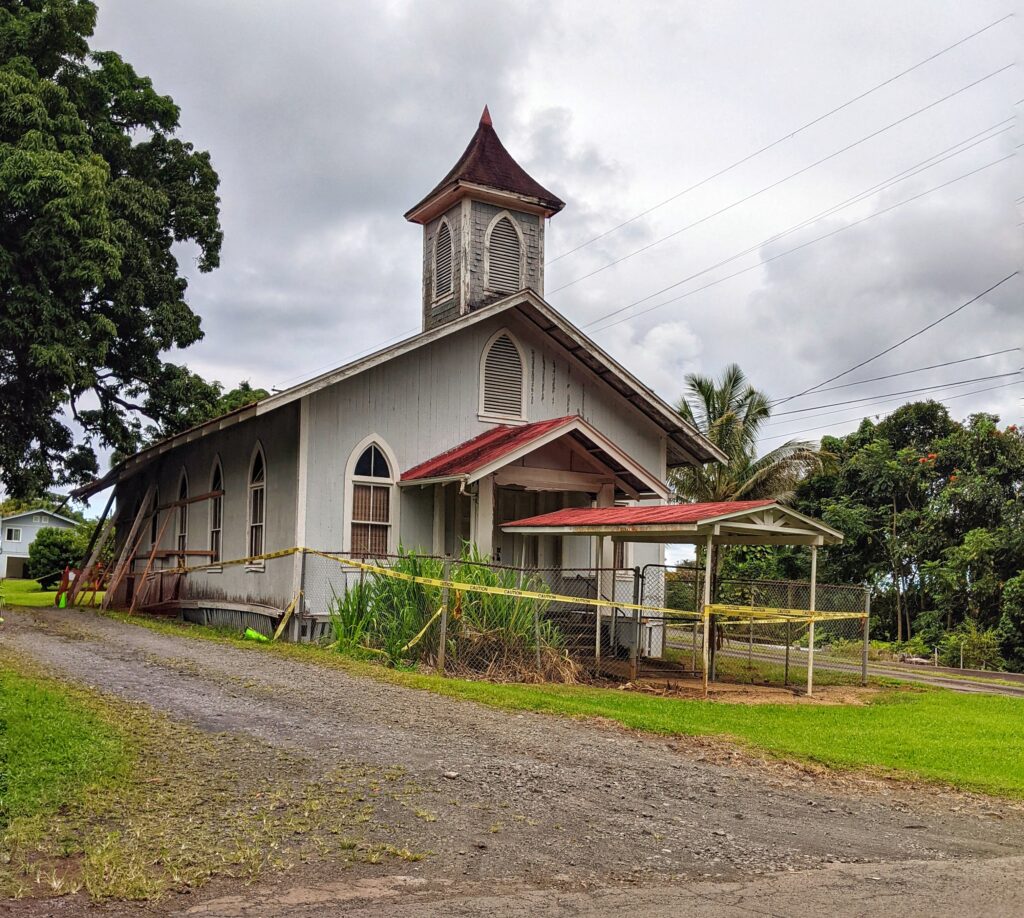
Please note: this abandoned church collapsed during a storm and is just a pile of rubbish now. But it’s good to know what it used to look like.
A lot of this road is residential living (my favorite house has a floor-to-ceiling windowed room hanging over a creek!), but the first point of interest you’ll pass is the remnants of an abandoned church. It’s roped and gated off but it was a quaint steepled chapel that seemed out of place on this road.
If you know the history behind it I’d love to hear it!
2. Cemetery
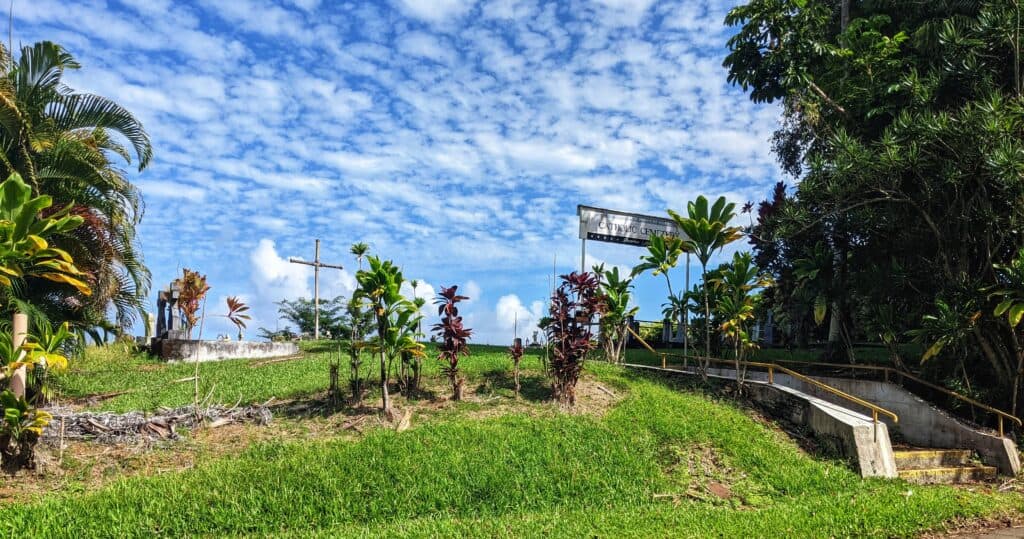
Next up on the right you’ll pass the Immaculate Heart of Mary Catholic Cemetery. You might miss it as there is a small mound that hides most of the cemetery grounds, but a few headstones are viewable from the road.
The church that runs the cemetery, Immaculate Heart of Mary Church, is located on the opposite side of Hwy 19 from the Old Mamalahoa entrance.
There are signs that say private property and no trespassing, so I’m not sure if you can actually walk the cemetery grounds or not.
3. Tropical Road
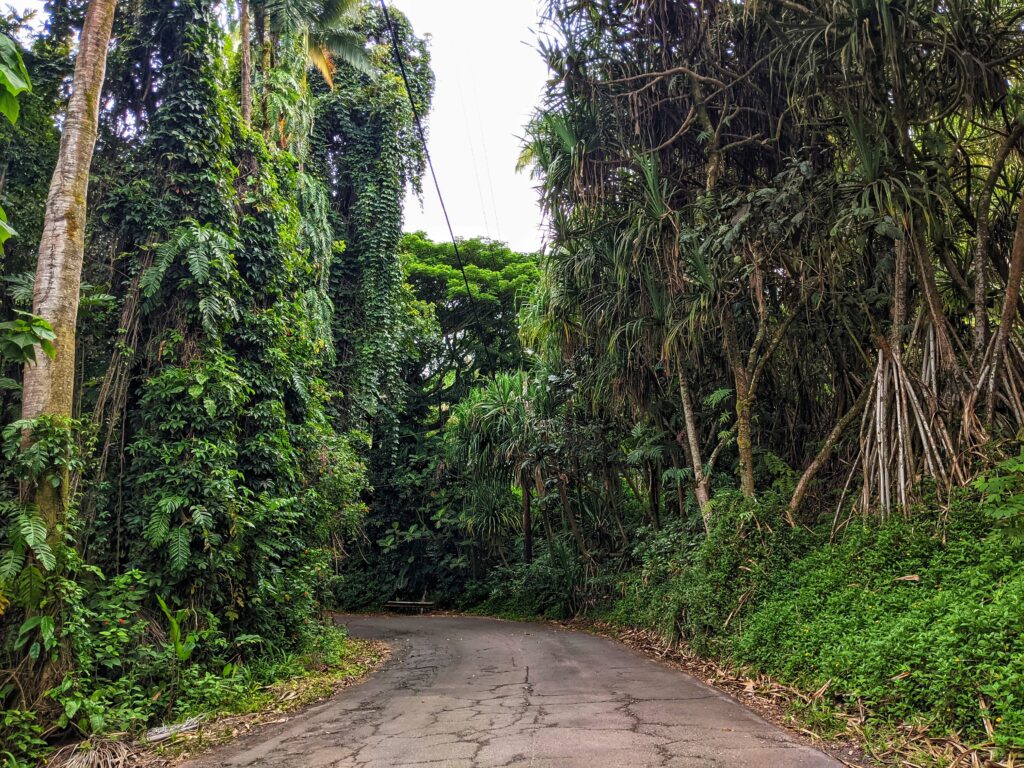
Once you pass the cemetery you’ll almost immediately enter into the mystical tropical drive. As you drive between two exposed root “walls”, it’s like a gateway into a different world.
For the next mile or so you’ll be driving within a forest assembled of looming ivy-covered tree pillars, blockading fern walls, and stones tucked safely under moss blankets.
This is the whole reason I love this Hilo scenic drive. 🥰
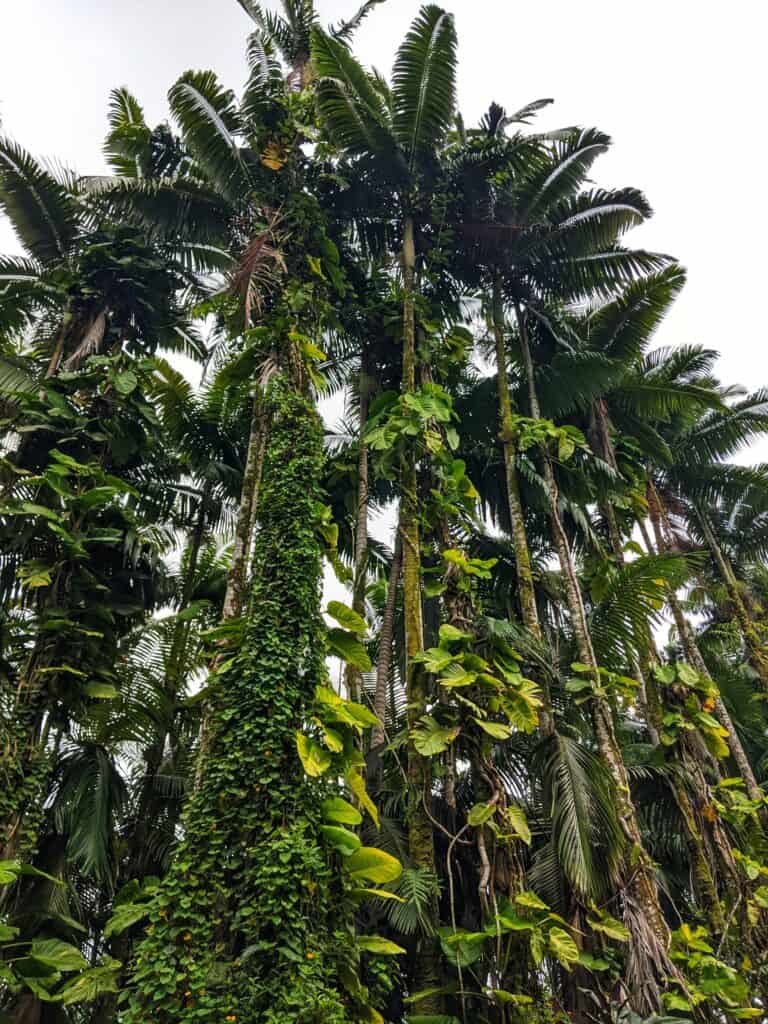
The first stream crossing in this section of the route is Kalaoa Stream Bridge, built in 1925.
4. Hanawi Bridge
The next bridge was built in 1922 and crosses Hanawi Stream.
Look for moss graffiti on the bridge walls.
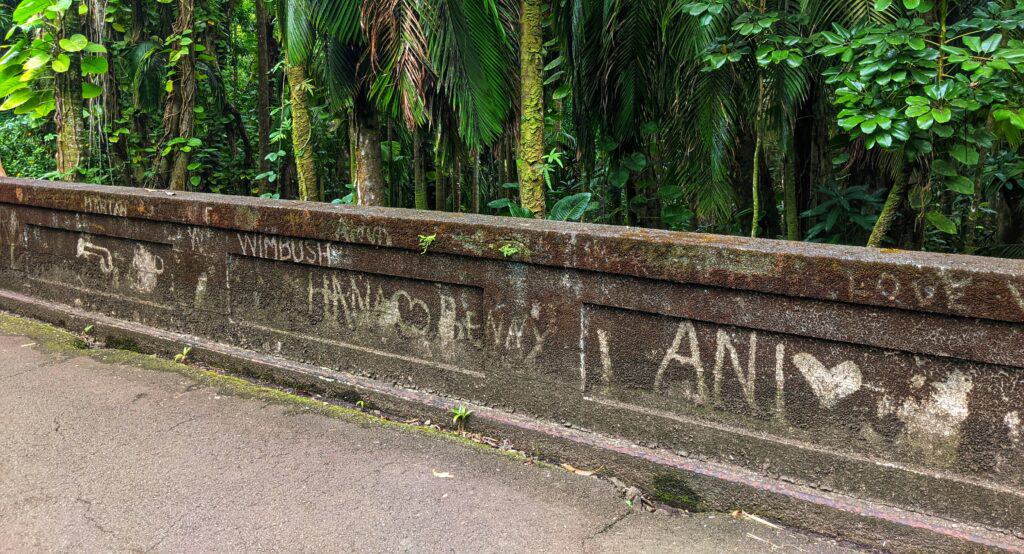
You can park along the shoulder on the edge of the bridge.
On the right side of the road once you’ve crossed the bridge there is a path that leads to the stream.
When I was there the trail was a mini dump with large items of trash strewn on the side of the trail and the area smelled like an outhouse. I’m not sure if that’s the norm though.
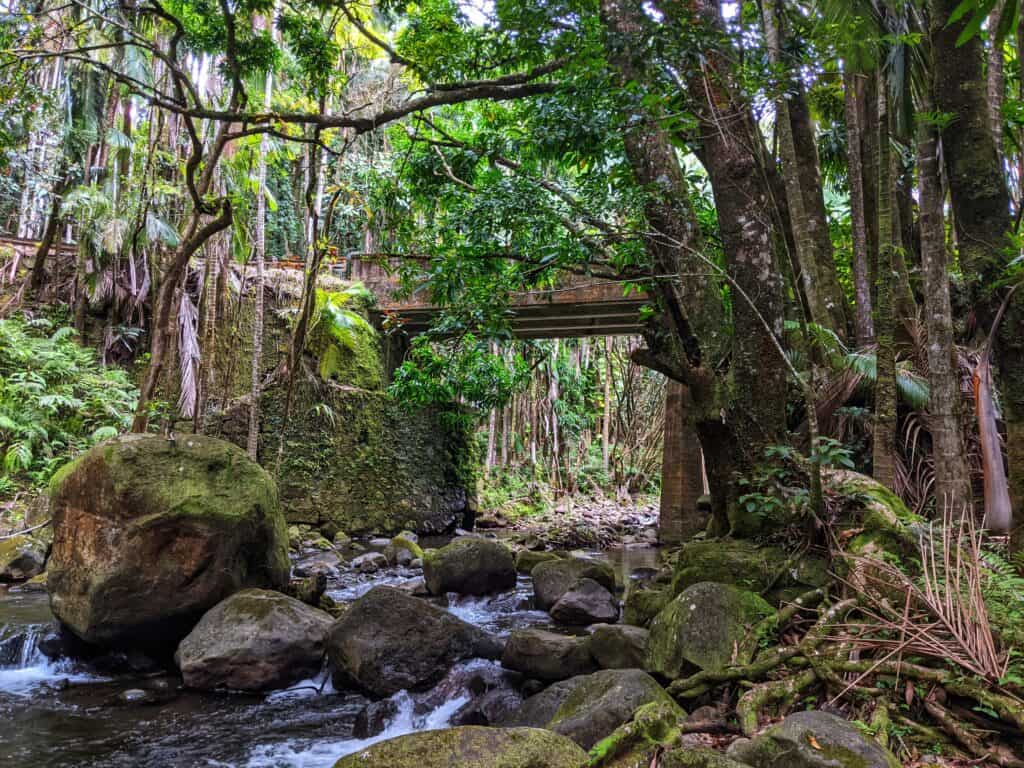
The view from the stream to the bridge was picturesque and it’s a good spot for boulder hopping.
The depth of the stream will be dependent on how much rain it’s gotten lately.
5. Onomea Trails
Continuing on you’ll reach the most congested area of the drive. Most likely you’ll see a few congregated cars pulled off on the gravel shoulder.
This is the Onomea Trails trailhead.
Three trail systems are connected here:
- Onomea Trail
- Alakahi Trail
- Donkey Trail
The Donkey Trail is named after the actual trail donkeys used in the 1800s to transport cargo from Onomea Bay port to the sugar mills.
The entirety of the trail system is about 1.25 miles, most on the old government road.
You can choose to do all or part of this easy hike.
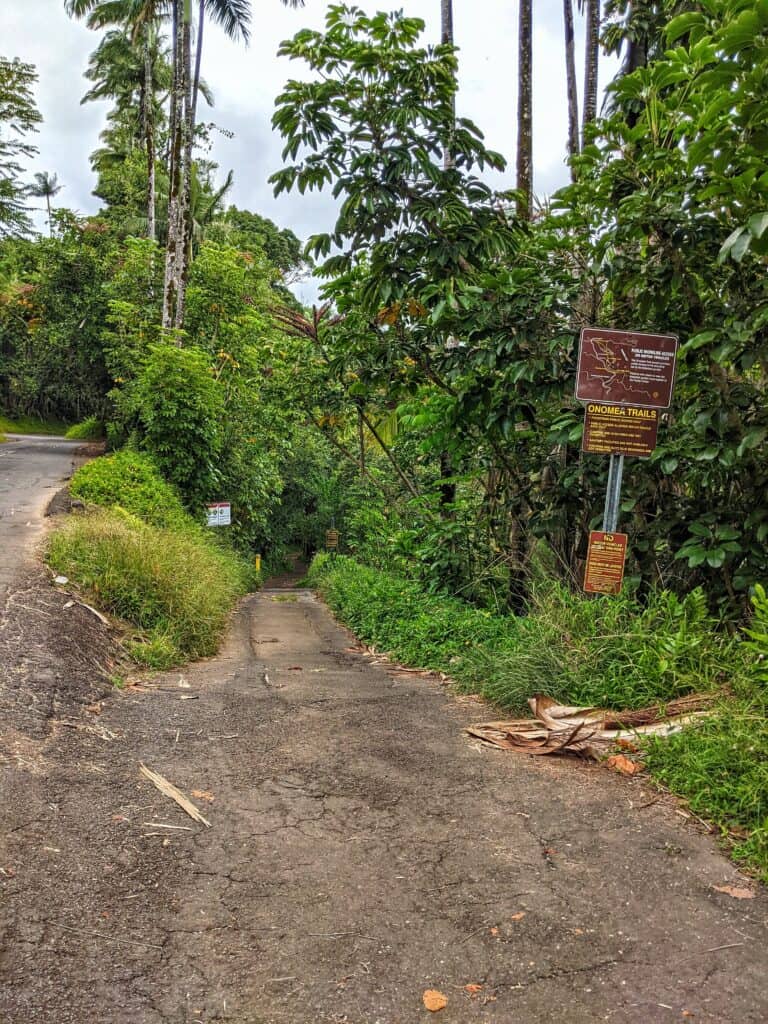
If you intend to visit the Hawaii Tropical Bioreserve & Garden just bypass this stop as you’ll be coming back to this area while exploring their grounds.
If the Hawaii Tropical Bioreserve & Garden is not on your list I highly suggest at least hiking down the hill to get sea level with Onomea Bay (or Kikulu Bay).
It’s a little steep of a climb, but short and doable.
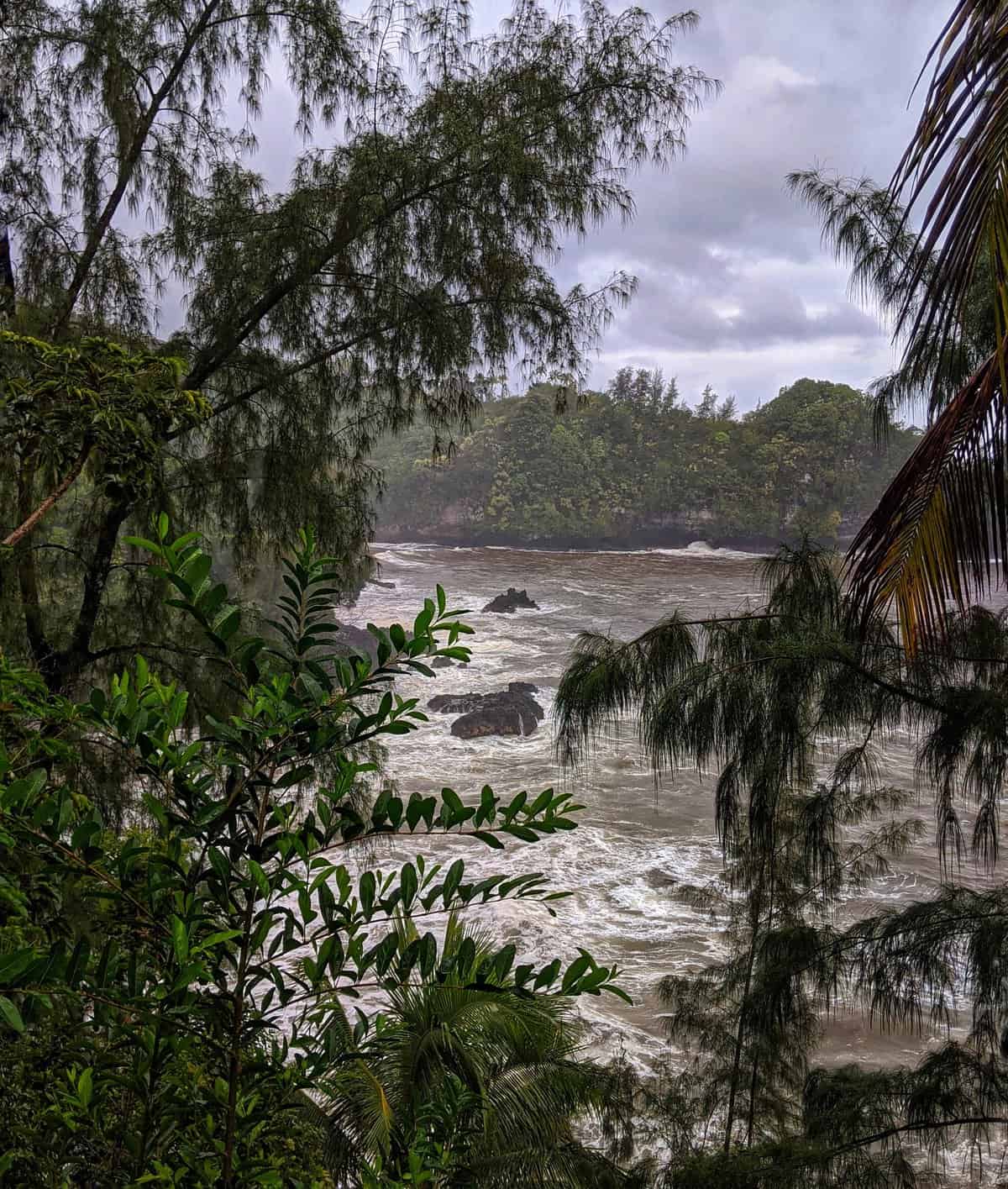
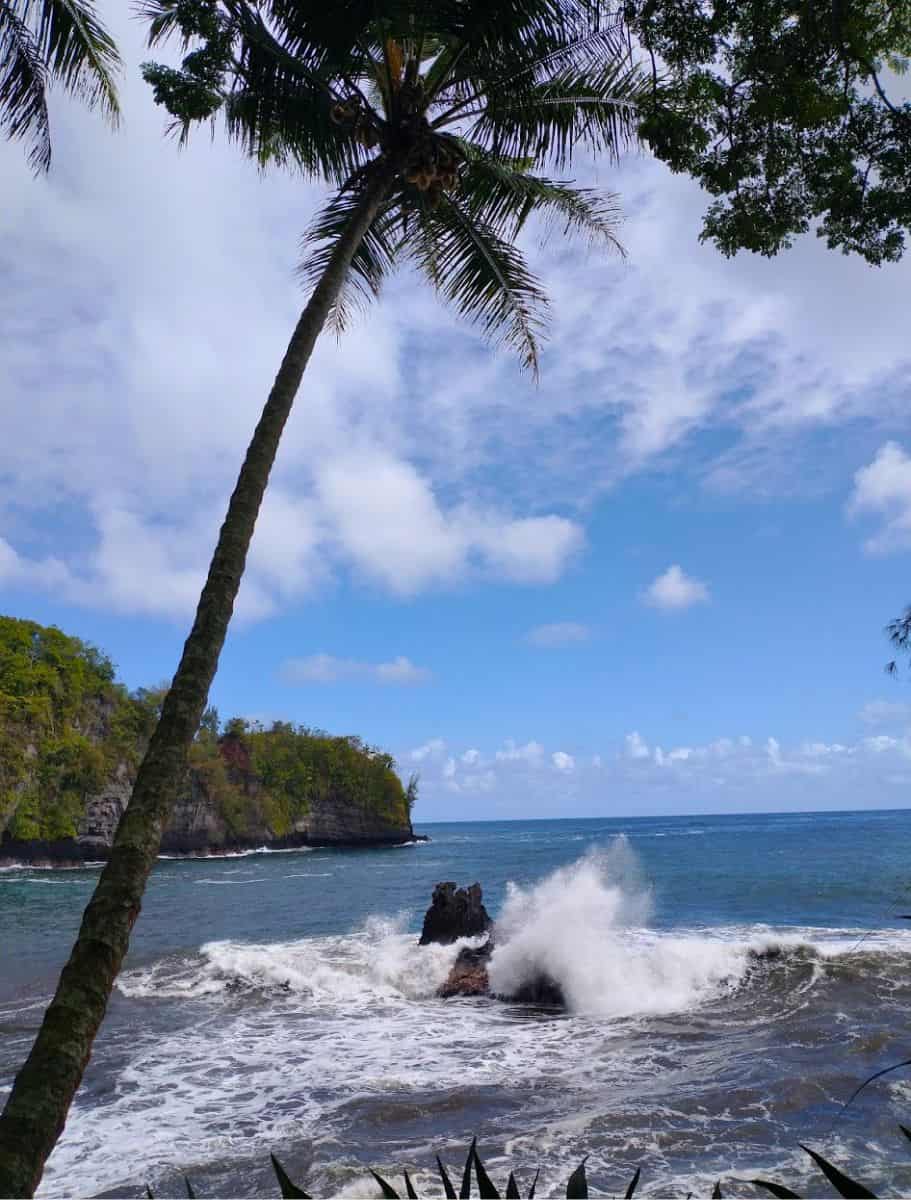
As you descend you’ll be given peek-a-boo views of the crashing waves below the cliffs.
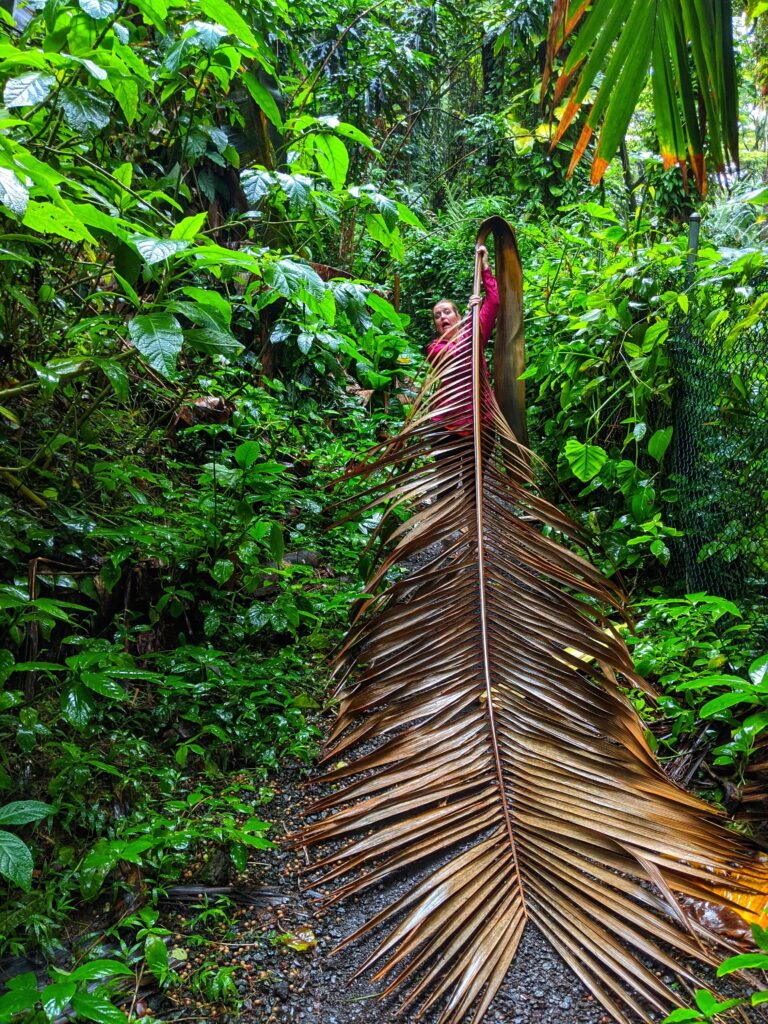
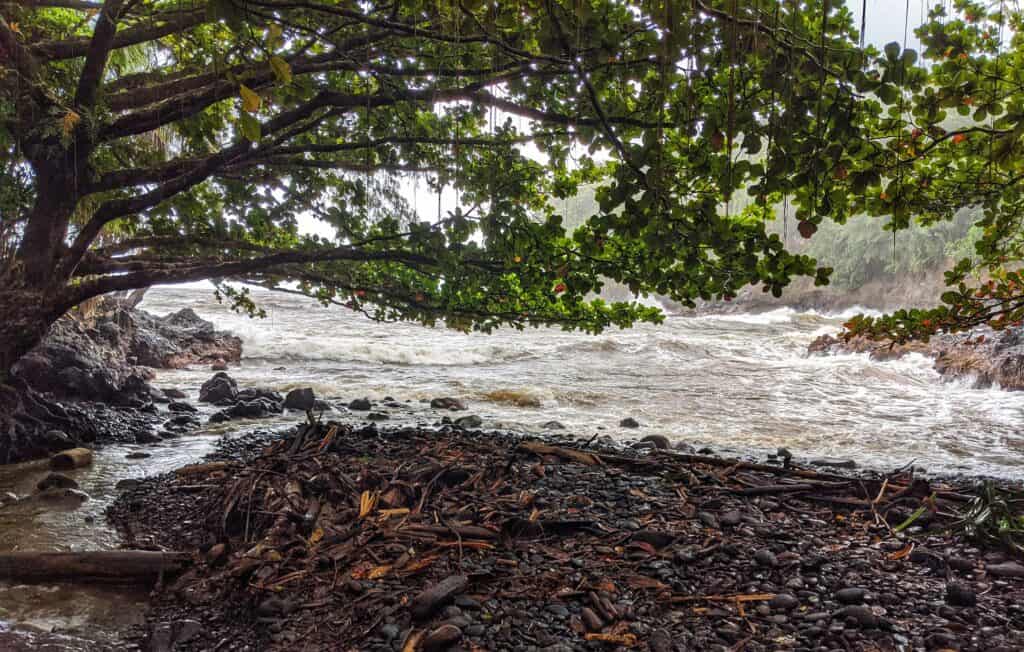
Before you cross the bridge when the ground levels, there is a path to the right along the chain link fence that brings you to the bay.
The “beach” is all rocks canopied with trees.
The ocean waves can be very ominous as they come charging at you like cavalry.
If you keep following the trail you’ll be passing through the Hawaii Tropical Bioreserve & Garden property, which is blocked off with chain link fencing. You must pay admission to explore their gardens which you can do once you get back on the road.
The trail continues on until it ends at the Donkey Trail trailhead next to the Hawaii Tropical Bioreserve & Garden entrance.
6. Hawaii Tropical Bioreserve & Garden
In 1977, Dan Lutkenhouse Sr bought 17-acres in Onomea Valley. He decided he wanted to preserve the area of its natural beauty and create a botanical garden.
Everyday for seven years he would go out with hand tools and clear paths through the forest, finding waterfalls and historical artifacts. In 1984 he opened the Garden to the public and continued to cultivate the land for another 17 years.
Today Hawaii Tropical Bioreserve and Garden is still owned and run by his children.
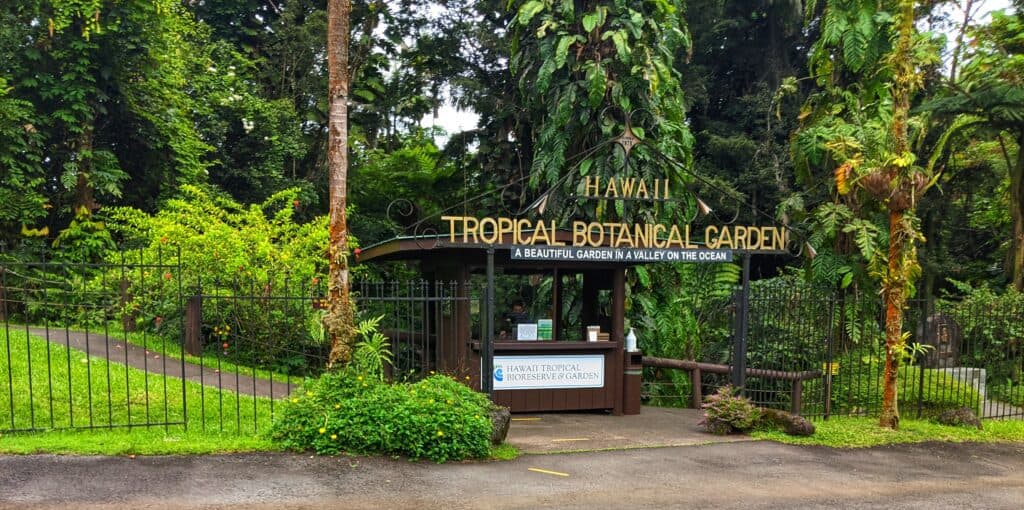
Park your car in the parking lot to the left of the road. On the right is the gated entrance to the park.
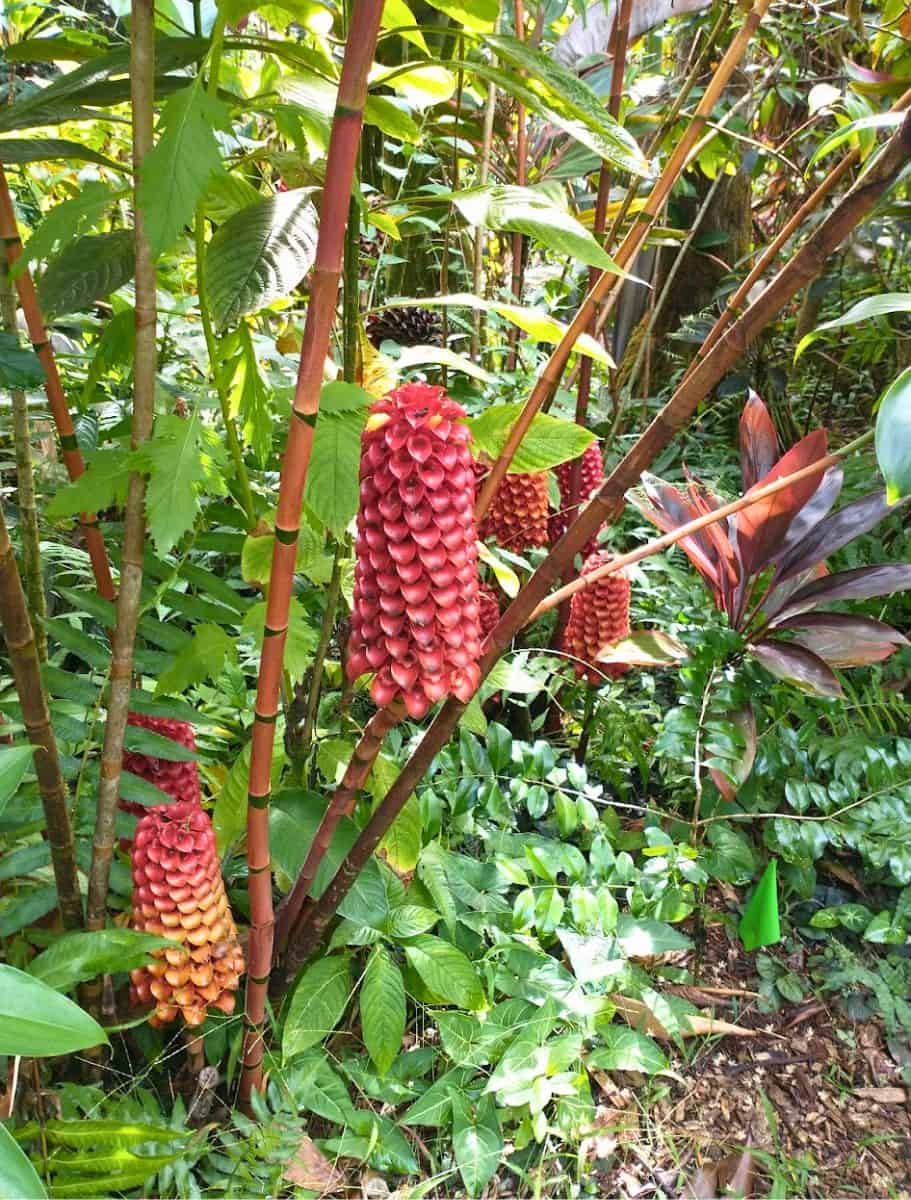
Explore 20 acres of lush vegetation with over 2500 plant species from around the world. They describe their property as a living classroom as there is so much to discover and learn.
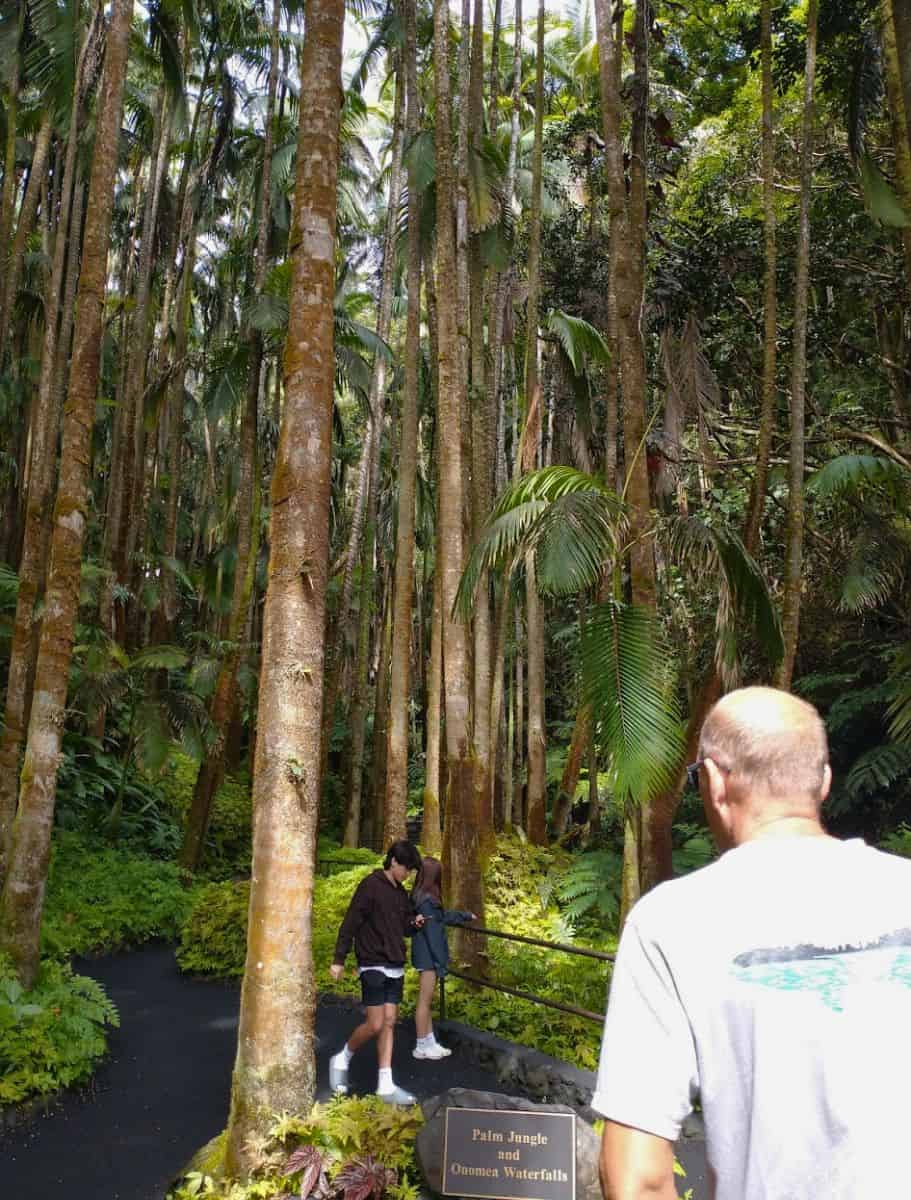
The trails that meander amongst the flora are about 1.25miles in length.
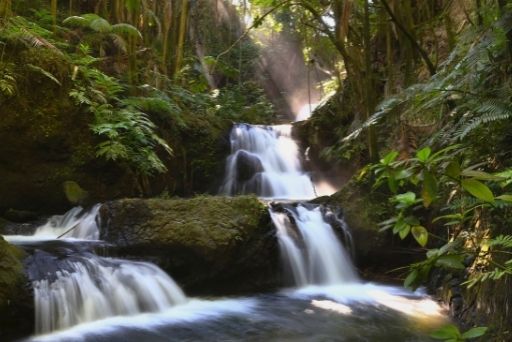
If you are playing waterfall bingo you’ll be able to check off two here:
- Onomea Falls
- Boulder Creek Falls.
The paths will take you through various foliage, by a bird house, and outside of the property gates down to Onomea Bay.
The average stay here for people who love botany or not is about 1.5hrs.
Hours: 7 days a week 9:00am-5:00pm
7. Six Tons
My favorite stop on the Pepe’ekeo Scenic Drive at Six Tons, a two-for-one waterfall stop.
You’ll cross a wooden bridge with white railings originally built in 1900.
Park on the other side of the bridge on the gravel shoulder.

On the mauka side (mountain side) of the road is Six Tons.
There is a debate on whether Six Tons is a waterfall or just white rapids. Regardless, it’s beautiful as Kawainui Stream comes out of the man-made tunnel.
The pool below it is swimmable and some people will jump from the platform-like boulder.
The path to get down to the stream is on the makai side (ocean side) of the road after you cross the bridge.
What makes this my favorite stop is what is hiding at the end of the path if you follow it downstream.
Not 5 minutes of walking and you’ll find yourself at the top of a real waterfall.
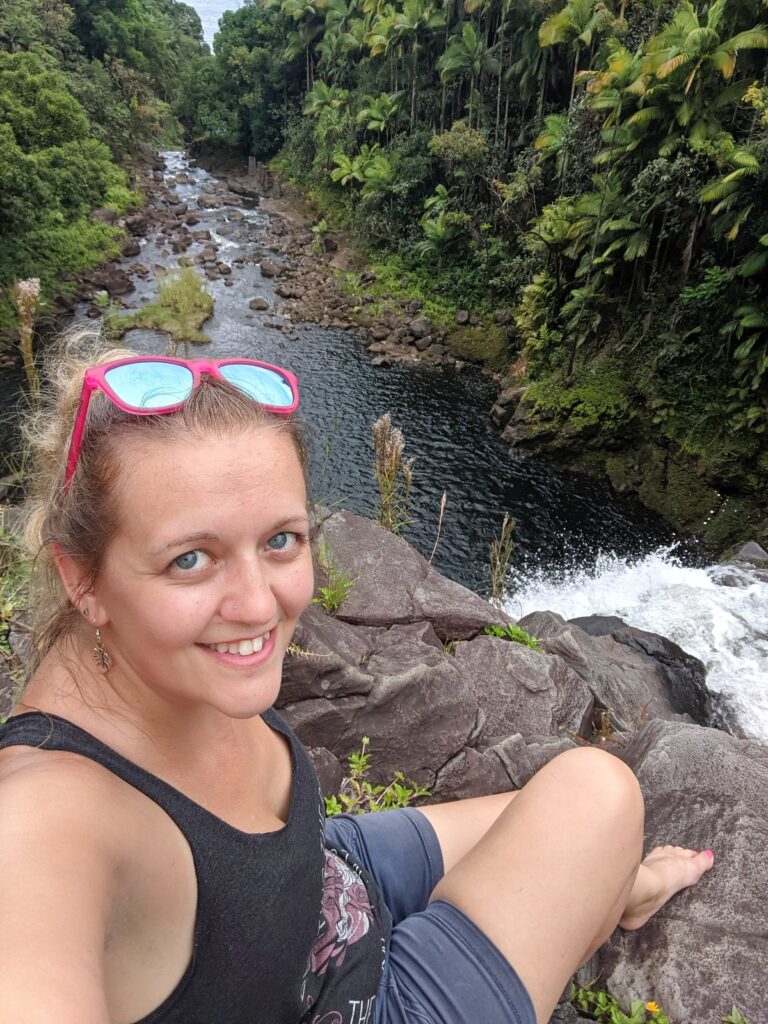
I don’t know the name of this waterfall or how high it is (my guess is 40ft?) but you’ll likely have it to yourself.
Very carefully perch yourself on the boulders as the water cascades below your feet.
There is a giant pool beneath the falls and the water continues on its way downstream through more boulders and you can almost see the ocean through the trees in the horizon.
8. What’s Shakin’
What’s Shakin’ is one of my favorite lunch spots in the Hilo area.
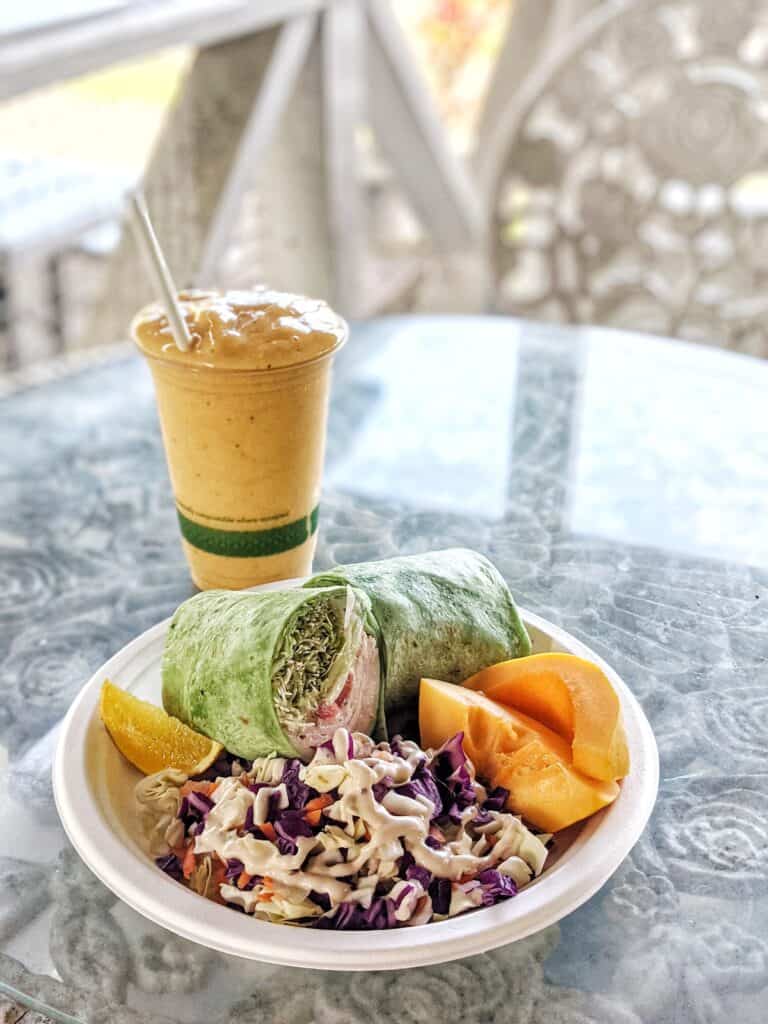
They are best known for their smoothies, using mostly locally sourced frozen fresh fruits with no ice that waters it down or unhealthy added sugars.
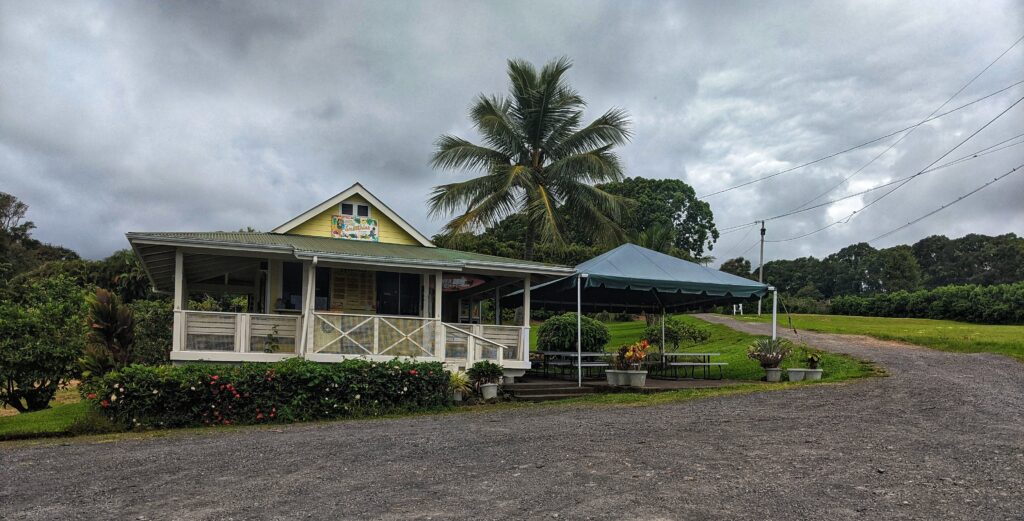
If you’re famished for a meal, I am always craving What’s Shakin’ a wrap plate with a made-to-order wrap, salad/slaw, and fresh fruit.
A chance to get your quintessential Hawaiian pic with a chilled fresh coconut is also an option.
Hours: Wed-Sun 10am-3pm; Mon-Tues closed
9. Onomea Country Market
Just a little further down is Onomea Country Market, a cute gift shop and shave ice stop.
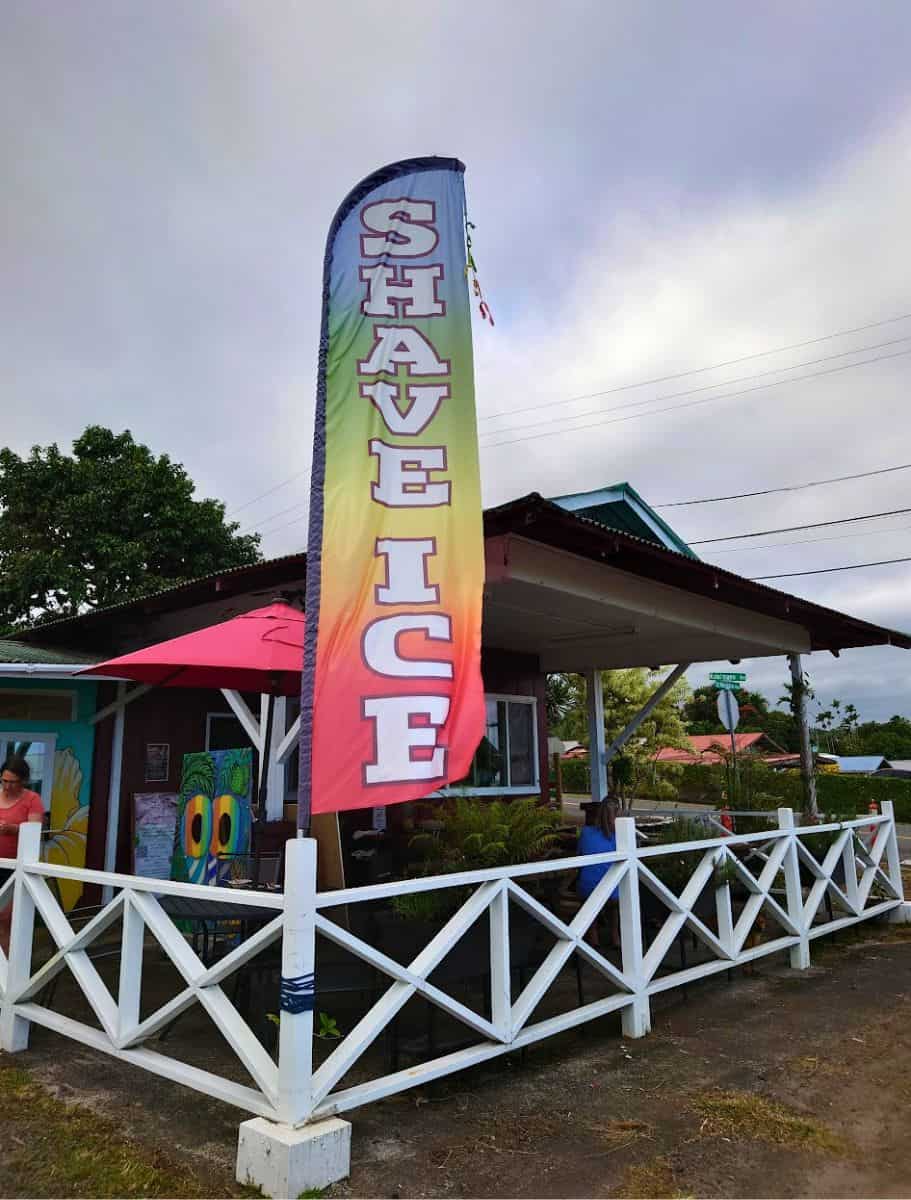
There are tables and chairs on the covered lanai where you can enjoy some shave ice with lots of flavors to choose from.

I was surprised with the unique items they had in their gift shop. It was mostly locally made foods and crafts, even stuff I hadn’t seen in other tourist stores, like ulu flour and lilikoi-glazed macadamia nuts.
Hours: Monday – Sunday: 10am – 6pm
10. Pepeekeo Park
Across the street from Onomea Country Market is Pepeekeo Park. It doesn’t consist of much, just a large grassy field and cracked asphalt basketball court.
There is a parking lot for easy access and it would be a pleasant place to picnic on the lawn with your food from Onomea Country Market.
11. Pepeekeo Sugar Company
From here on out the road opens up to more of a straight away across more farm and pasture land.
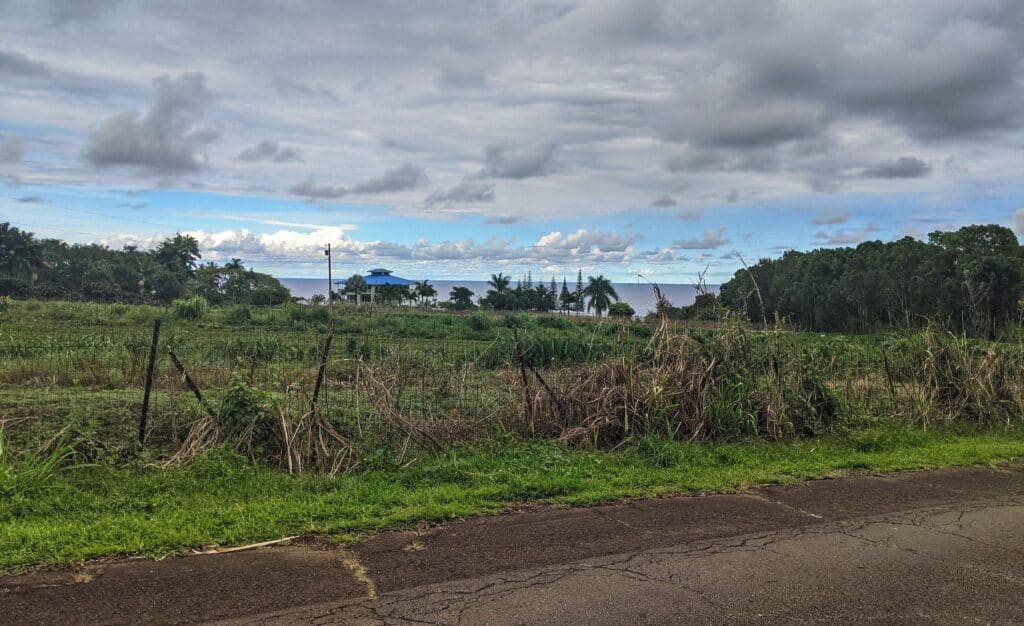
This area used to be sugar fields on the Metcalf Plantation which was started in 1857. It was later sold in 1874 and became the Pepeekeo Sugar Company.
Throughout the years the company prospered through innovative tactics. It was the first factory in Hawaii to use a vacuum pan, which rapidly evaporates the sugar syrup into sugar crystals.
The warehouse had a system of loading thousands of bags of sugar onto interisland steamers by steel cables from the sea cliffs.
They initiated a farming method of using sugar cane trash for fertilizer instead of burning it off, thus improving the soil; even the Hawaiian Sugar Planters Association took note and implemented it to other plantations.
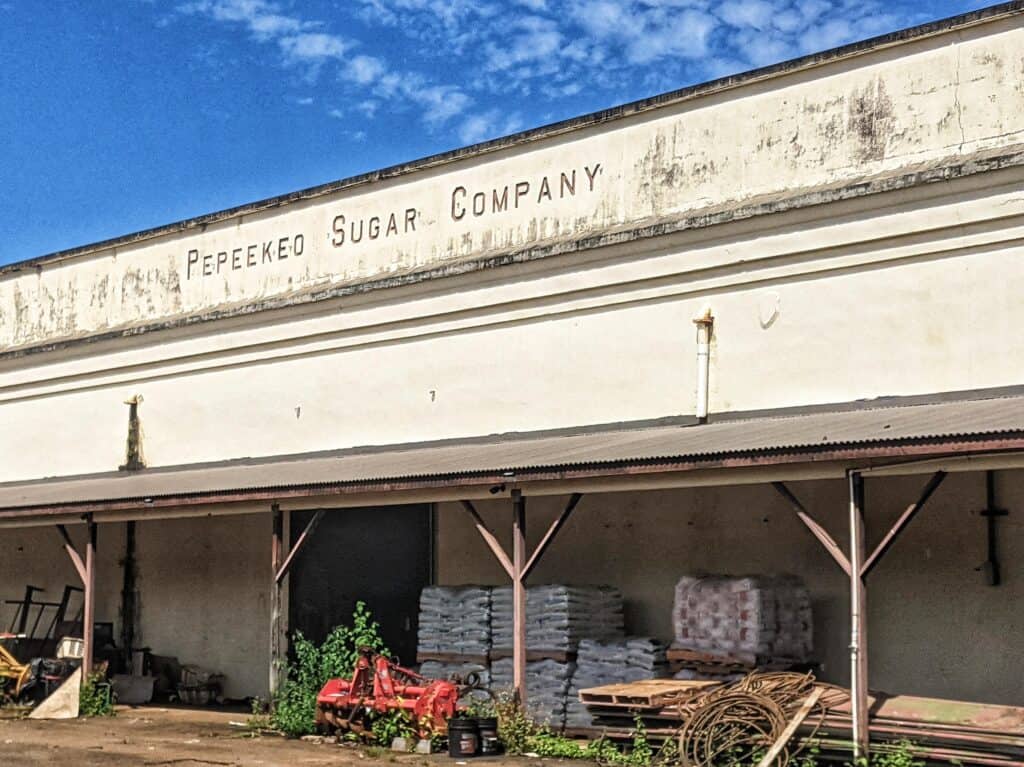
In 1973 Pepeekeo Sugar Company merged with Mauna Kea Sugar Company and continued to thrive until it met its demise in the 1990s with all the other sugar plantations on the island.
You can read more about its history here.
As you connect back with Hwy 19 off of Sugar Mill Rd, you’ll see a remnant of what I presume to be from the sugar mill there on the corner.

🤙 Continue exploring the Hamakua Coast with the
North Island Jungle Adventure Loop Tour on the Shaka Guide App
History of Old Mamalohoa Hwy
The Mamalahoa Hwy, also known as Hawaii Belt Rd, circumnavigates the Big Island in 260.4 miles.
The name Mamalahoa comes from a royal decree by King Kamehameha I after he had a run-in with some fishermen.

In 1783, Kamehameha I was conducting a habitual raid along the Puna coast, asserting his dominance. His party came across two fishermen who tried to flee and warn the others about the impending attack.
As Kamehameha I was chasing them through a lava field his foot got stuck in a crevice. One of the fishermen carpe diemed and struck the king over the head with a koa wood canoe oar so hard that it split into a bunch of pieces. (and as I’m writing this I’m trying to picture why a fisherman running for his life had an oar in his hand?)

Obviously Kamehameha I lived to tell the tale; unfortunately one of his soldiers did not. Ten years later the king went on to proclaim Ke Kānāwai Māmalahoe, the “Law of the Broken Paddle”, in memory of this fallen warrior. It reads:
O my people
Honour thy God,
Respect alike [the rights of] the great man
and the humble man;
See to it that the old man,
the aged woman and the child
Sleep by the side of the path
Without the fear of harm.
Disobey, die!
The way I understand it, he was embarrassed he was overtaken by weak fishermen and didn’t want that to happen again. So he made a law for himself and those like him to not mistreat those who are lesser and who are just trying to get from point A to point B on the road.
This law was added to the Constitution of Hawaii in 1978 and still exists today.
That is where the name of the Mamalahoa Hwy comes from. The highway route itself follows a 19th century foot trail. Over the years it became an actual road and has been widened and realigned as necessary.
What the Big Island is left with is fragmented pieces of the Old Mamalahoa Hwy. Some of these roads are rather beautiful and go through quiet residential neighborhoods.
Pepe’ekeo Scenic Drive is the most popular section of the Old Mamalahoa Hwy as there is quite a fair amount to see. So let’s get going!
For other Big Island road trips, check out:
• Mauna Loa Road
• 3 Ways to Get From Kona to Hilo
Exit Pepe’ekeo Scenic Drive
For only being 4 miles long, the Pepe’ekeo Scenic Drive along the Hamakua Coast is full of interesting sites to see. Let it inspire you to take other parts of the Old Mamalahoa Hwy less traveled and perhaps discover secrets for yourself!
🌺 Big Island Travel Planning Guide 🌺
🚨 Should I buy Hawaii travel insurance?
YES — I recommend Travel Insurance Master because you can compare multiple options with one click. With plans starting at $5/day per person, why not give yourself piece of mind? Better to have it and not need it than need it and not have it!
🚗 Is it safe to rent a car on the Big Island?
YES — It’s totally safe to drive on the Big Island. And unless you plan to chill by the resort pool the entire time, renting a car is pretty much a necessity on the Big Island! Jeep rentals are popular. I recommend Discount Hawaii Car Rental, as they have some of the best prices around.
📞 Will my phone work on the Big Island?
PROBABLY — Most, if not all, cell providers work on the Big Island. However, be prepared for some dead spots in the more remote parts of the island. For example, I always lose service driving through Hawaii Volcanoes National Park.
🛏️ What’s the best way to book my Big Island accommodations?
For Big Island hotels, Booking.com is amazing because you can often reserve your room with no money down. If you are looking for an Airbnb condo with a kitchen and more space, don’t forget to check VRBO for potentially better prices and options.
✈️ What’s the best site to buy Big Island flights?
I recommend looking at Skyscanner for finding cheap flights. Pro Tip: check if flying into Hilo is cheaper than flying into Kona.
🛂 Do I need a passport to visit Hawaii?
NO — If you are a US citizen, you do not need a passport as Hawaii is part of the United States. If you are from out of the country, the same passport and visa requirements are the same as entering anywhere in the United States from your country.
🧳What should I pack to the Big Island?
Pack for tropical weather but also prepare for colder than expected nights and early mornings, so a light sweatshirt is recommended. Check out this list of 5 Things Not to Forget to Pack.
🌺 Big Island Travel Planning Guide 🌺
🚨 Should I buy Hawaii travel insurance?
YES — I recommend Travel Insurance Master because you can compare multiple options with one click. With plans starting at $5/day per person, why not give yourself piece of mind? Better to have it and not need it than need it and not have it!
🚗 Is it safe to rent a car on the Big Island?
YES — It’s totally safe to drive on the Big Island. And unless you plan to chill by the resort pool the entire time, renting a car is pretty much a necessity on the Big Island! Jeep rentals are popular. I recommend Discount Hawaii Car Rental, as they have some of the best prices around.
📞 Will my phone work on the Big Island?
PROBABLY — Most, if not all, cell providers work on the Big Island. However, be prepared for some dead spots in the more remote parts of the island. For example, I always lose service driving through Hawaii Volcanoes National Park.
🛏️ What’s the best way to book my Big Island accommodations?
For Big Island hotels, Booking.com is amazing because you can often reserve your room with no money down. If you are looking for an Airbnb condo with a kitchen and more space, don’t forget to check VRBO for potentially better prices and options.
✈️ What’s the best site to buy Big Island flights?
I recommend looking at Skyscanner for finding cheap flights. Pro Tip: check if flying into Hilo is cheaper than flying into Kona.
🛂 Do I need a passport to visit Hawaii?
NO — If you are a US citizen, you do not need a passport as Hawaii is part of the United States. If you are from out of the country, the same passport and visa requirements are the same as entering anywhere in the United States from your country.
🧳What should I pack to the Big Island?
Pack for tropical weather but also prepare for colder than expected nights and early mornings, so a light sweatshirt is recommended. Check out this list of 5 Things Not to Forget to Pack.


